How to Build a Scalable B2B Lead Generation System with AI
Learn how to build a scalable B2B lead generation system using AI and automation—from finding the right prospects to enrichment, personalization, outreach, and follow-up.
How to Build a Scalable B2B Lead Generation System with AI
Introduction
Generating B2B leads consistently is difficult when your sales process depends on manually searching for prospects, verifying information, writing outreach messages, and following up one lead at a time.
AI and automation can change that.
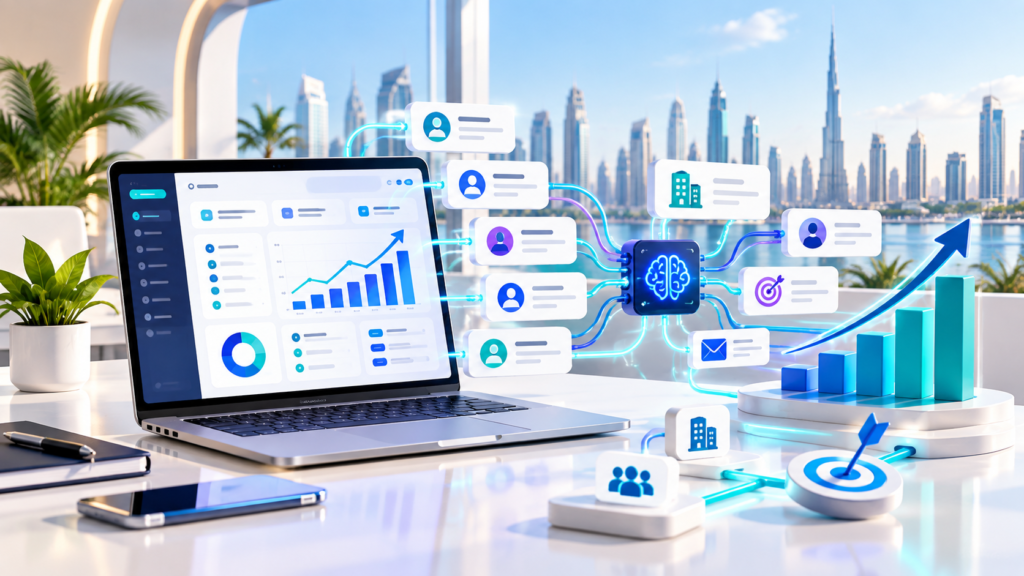
Instead of treating lead generation as a series of disconnected manual tasks, businesses can build a repeatable system that identifies the right prospects, enriches their data, personalizes outreach, and keeps follow-ups organized.
In this guide, we’ll look at how to build a scalable AI-powered B2B lead generation system.
What Is AI-Powered B2B Lead Generation?
AI-powered B2B lead generation combines data, automation, and artificial intelligence to identify and engage potential customers more efficiently.
A typical system can help with:
- Finding companies that match your ideal customer profile
- Identifying relevant decision-makers
- Collecting and organizing prospect information
- Enriching company and contact data
- Segmenting prospects
- Creating personalized messaging
- Automating outreach
- Tracking responses and follow-ups
- Measuring campaign performance
The goal isn’t to remove humans from the sales process.
The goal is to remove repetitive work so sales teams can spend more time on qualified opportunities.
1. Start With Your Ideal Customer Profile
Before collecting thousands of leads, define exactly what a good customer looks like.
Your ICP can include:
- Industry
- Company size
- Revenue
- Location
- Business model
- Technology used
- Growth stage
- Job titles
- Department
- Specific business problems
For example, instead of targeting every B2B company, you could define an ICP such as:
US-based B2B SaaS companies with 11–50 employees that are actively growing their sales team.
A specific ICP makes every following step more accurate.
2. Build Your Prospect Database
Once the ICP is defined, start identifying companies that match it.
Your prospecting workflow can collect information such as:
- Company name
- Website
- Industry
- Employee count
- Location
- Revenue range
- LinkedIn URL
- Decision-maker name
- Job title
- Company description
The important principle is to build a structured database rather than a simple list of names.
A structured database allows you to filter, segment, enrich, and prioritize prospects later.
3. Identify the Right Decision-Makers
Finding the company isn’t enough.
You also need to identify the person most likely to influence the buying decision.
Depending on the product, this could be:
- Founder
- Co-founder
- CEO
- CTO
- Head of Sales
- VP Sales
- Head of Marketing
- Marketing Director
- Operations Manager
The correct persona depends on your product and ICP.
4. Enrich Your Lead Data
Raw prospect data is often incomplete.
Data enrichment can add useful information such as:
- Company size
- Industry
- Website
- Technology stack
- Location
- Job title
- Social profiles
- Business description
- Other qualification signals
This gives your sales team more context before contacting a prospect.
5. Segment Your Leads
Don’t send the same message to every prospect.
Create segments based on characteristics such as:
Industry
- SaaS
- Fintech
- E-commerce
- Professional services
Company Size
- 1–10
- 11–50
- 51–200
- 201–500
Persona
- Founder
- Sales leader
- Marketing leader
- Operations leader
Pain Point
- Lead generation
- Sales automation
- Data collection
- Prospecting
- Marketing automation
Segmentation makes personalization much easier.
6. Use AI for Personalized Outreach
AI can help create personalized messages using information already collected about each prospect.
Instead of:
Hi, we help businesses generate leads. Would you like to learn more?
A personalized message could reference the company’s industry, growth, product, or current situation.
The important point is that AI should use real prospect information, not generate random personalization.
Good personalization answers:
- Why this company?
- Why this person?
- Why this solution?
- Why now?
7. Automate Follow-Ups
Many potential opportunities are lost because the first message doesn’t receive a response.
A lead generation system should therefore include follow-ups.
For example:
Day 1: Initial outreach
Day 4: Follow-up with additional value
Day 8: Share a relevant resource or insight
Day 14: Final follow-up
The exact timing depends on the channel and audience.
Automation ensures that qualified prospects don’t disappear simply because someone forgot to follow up.
8. Connect Lead Generation With Your CRM
Your lead generation system should eventually connect with your CRM.
Important fields can include:
- Lead source
- Company
- Contact
- ICP segment
- Lead status
- Outreach status
- Last contacted
- Response
- Meeting booked
- Opportunity status
This creates a single source of truth for your sales process.
9. Measure the Right Metrics
Generating more leads doesn’t necessarily mean generating better leads.
Track metrics such as:
- Leads generated
- Qualified leads
- Contact rate
- Response rate
- Positive response rate
- Meetings booked
- Conversion rate
- Cost per qualified lead
- Pipeline generated
These metrics help identify where the system needs improvement.
10. Build a Continuous Lead Generation Engine
The biggest advantage of automation is that lead generation becomes a repeatable process.
A scalable system can follow this workflow:
Find → Enrich → Qualify → Segment → Personalize → Contact → Follow Up → Track → Optimize
Each stage can then be improved independently.
For example:
If response rates are low, improve the messaging.
If qualification is poor, improve the ICP.
If too much time is spent researching companies, automate enrichment.
If follow-ups are being missed, automate the workflow.
Common Mistakes to Avoid
Targeting Everyone
A larger database doesn’t automatically mean more customers.
Using Generic Outreach
Automation without personalization can make outreach feel robotic.
Ignoring Data Quality
Incorrect emails, outdated company information, and duplicate records reduce campaign performance.
Focusing Only on Lead Volume
A smaller number of highly relevant prospects can be more valuable than thousands of poorly matched leads.
Automating Everything Immediately
First understand the process manually. Then automate repetitive parts.
Final Thoughts
A scalable B2B lead generation system isn’t simply a scraping tool or an email automation workflow.
It’s a connected process that combines:
Data + ICP + Enrichment + AI + Personalization + Automation + CRM + Analytics
When these pieces work together, businesses can spend less time on repetitive prospecting and more time turning qualified opportunities into customers.
The key is to start with a clear ICP, build reliable data, automate repetitive tasks, and continuously optimize the system based on real results.
That’s where AI-powered lead generation becomes a growth engine rather than just another sales tool.
See how Zilvo builds your prospect list
Collect selected LinkedIn results and local business data into one list.